
Notarial will
A notarial will is a "will made before an authority" under section 22 of the Succession Law, 5725-1965. The Law provides that, for the purposes of such a will, a notary has the same standing as a judge (section 22(g) of the Succession Law), and the will is prima facie evidence that the testator made it on the date and at the place stated in it (section 22(f) of the Succession Law).
Amos Ilan, Advocate and Notary, drafts the will and certifies it, or certifies a text that you, or an advocate on your behalf, have prepared in advance.
When a notarial will is advisable
- When you want the will to be made before an official authority, with authoritative documentation of the date and place at which it was made.
- When you wish to distribute the estate otherwise than in the order of succession laid down by law, or when a family dispute is anticipated.
- When you wish to carry out tax planning and to balance the shares of the heirs with minimal future taxation.
- When the testator is elderly, or when it matters to him that the will be read out and explained to him before he signs.
- When the testator cannot read the language of the will: section 22(c) of the Succession Law requires the will to be read to him in a translation into a language he understands, with the translator confirming this on the face of the will.
The process
Initial consultation
We establish what you wish to bequeath, to whom, and whether there is an earlier will.
Drafting
The advocate drafts the will, or reviews the text you have brought.
Signing meeting
The will is read out to the testator, the testator declares that it is his will, and the notary certifies by his signature on the face of the will that this was done (section 22(b) of the Succession Law). The testator attends in person.
Deposit
The will may be deposited with the Registrar of Inheritance (section 22(e) of the Succession Law). In the case of a notarial will, if the testator so requests, the notary himself deposits the original will with the Registrar of Inheritance within 30 days of the date on which it was made, either in person at the Registrar's office or online through the Administrator General's website, at the testator's expense (regulation 23(a1) of the Notaries Regulations, 5737-1977).
What to bring
- A valid identity document: an Israeli identity card or a passport.
- The names and identity numbers of the heirs.
- A list of the main assets (not mandatory, but helpful for the drafting).
- Any earlier will.
- A person in hospital or confined to bed: a medical certificate in the form set out in the First Schedule to the Notaries Regulations, 5737-1977, issued on the day of signing. In the certificate, the doctor confirms that the person is fully conscious, of sound mind and competent to perform an act before a notary (regulation 4(e) of the Regulations).
Timing and cost
Timetable: an initial meeting can usually be arranged for the same day or the next. Drafting the will usually takes a few days, depending on its complexity. The will is signed and certified at a single meeting and handed to the testator as soon as it ends. If the testator asks for it to be deposited, the notary deposits it with the Registrar of Inheritance within 30 days of the date on which it was made (regulation 23(a1) of the Notaries Regulations).
Cost: the notary fee for certifying the will is fixed by regulation: NIS 293 for the first signatory and NIS 147 for each additional signatory. The amounts follow the 2026 tariff under the Notaries (Service Fees) Regulations, plus VAT. For an exact calculation for your service, see the notary fee calculator.
It is advisable to obtain several original copies, at NIS 88 plus VAT for each additional copy certified at the same time. The copies are best given to the heirs.
Drafting the will is separate legal work and is priced separately, according to its complexity.
If you cannot come to the office, you may request service at home, in hospital or in a care home. Under the regulations, a surcharge of NIS 645 for the first hour is then charged, plus travel expenses.
Notarial will compared with a will before witnesses and a handwritten will
| Form of will | How it is made |
|---|---|
| Handwritten (section 19 of the Succession Law) | Written entirely in the testator's own hand, and dated and signed by him. |
| Before witnesses (section 20 of the Succession Law) | In writing, dated, and signed by the testator before two witnesses, who confirm this by their signatures. |
| Before an authority (section 22 of the Succession Law) | Before a judge, a registrar, a member of a religious court or a notary. It is prima facie evidence of the date and place at which it was made, and no witnesses are needed. |
Every form of will recognised by the Law is valid. The difference lies in the way it is made and in how it is documented.
Frequently asked questions
Is a notarial will "stronger" than an ordinary will?
Every form of will recognised by the Law is valid. The advantage of a will made before an authority is that it is made before an authorised official, and that it is prima facie evidence that the testator made it on the date and at the place stated in it. It does not prevent an objection to the will from being filed.
Can the notary also draft the will?
Yes. Amos Ilan is also an advocate, so the will can be drafted at the office and certified there, or you can bring a ready-made text for certification only.
Are witnesses needed?
No. In a will made before an authority, the notary takes the place of the two witnesses.
Where is the will kept?
It can be deposited with the Registrar of Inheritance under section 22(e) of the Succession Law, or original copies can be given to the heirs.
Can a notary certify the will of a relative?
No. Under section 10 of the Notaries Law, a notary may not exercise his powers in a matter concerning a relative, such as a spouse, parent, descendant, brother or sister.
Can the will be signed at home or in hospital?
Yes. If you cannot come to the office, you may request service at home, in hospital or in a care home. Under the regulations, a surcharge of NIS 645 for the first hour is then charged, plus travel expenses. If the testator is hospitalised or confined to bed, the notary may certify the will only if he is shown a medical certificate, in the form set out in the First Schedule to the Notaries Regulations, issued on the day of signing. In the certificate the physician confirms that the testator is fully conscious, of sound mind and competent to perform an act before a notary (regulation 4(e) of the Notaries Regulations, 5737-1977).
Related pages: Continuing power of attorney | Prenuptial agreement | 2026 notary fees
Contact us
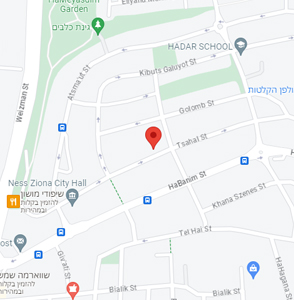
The office is at 17 Tzahal Street, Ness Ziona, in an area with easy access and parking on site. Most notarial services are also available online, without coming to the office.
- Phone and WhatsApp052-5927592
- Email[email protected]
- Address17 Tzahal Street, Ness Ziona, parking nearby
- Opening hoursSun-Thu 09:00-19:00, Fri 09:00-12:30
Getting here
17 Tzahal Street, Ness Ziona. Parking near the office, with service on the ground floor. The office is a short drive from Rehovot, Rishon LeZion and Yavne.
Get directions in Google MapsNot sure which certificate you need? Let's start with a conversation
Tell us which authority the document is intended for and for what purpose, and we will tell you exactly which notarial certificate you need, whether an apostille is required and in what order, and how much it will cost under the regulations.