
Our Services
A full description of the notarial services provided by the office: authentication of signatures, notarial powers of attorney, certified true copies, wills made before an authority, prenuptial agreements, certified notarial translation, affidavits, life certificates, protests and apostilles. The documents required are listed for each service.
Notarial power of attorney and continuing power of attorney
Full page: notarial power of attorney, the procedure, cost and frequently asked questions
A power of attorney enables one person to perform various acts that will bind another. Because a power of attorney can be used for significant financial transactions (such as buying and selling real estate, withdrawing funds, banking operations and more), the legislature saw fit to make its validity conditional on certification by a notary. The notary identifies the grantor and authenticates the grantor's signature.
There is one exception: a power of attorney given in Israel to an advocate, for matters connected with the professional services the advocate provides to the client, on which the advocate has certified the client's signature in writing, requires no further certification (section 91 of the Israel Bar Association Law). In that case no notarial certificate is needed.
Most of the notarial certificates we issue in this area are for a general power of attorney (for example, within the family, where the grantor is about to travel abroad for an extended period, and the like). Another common case is a real estate transaction in which the buyer is required to give a notarial power of attorney in favour of the developer and of the mortgagee bank.
To authenticate the signature, the notary must see the grantor in person, and the grantor signs the power of attorney in the notary's presence.
Documents required:
- The text of the power of attorney (where a bank or a developer is involved).
- Identification (preferably an identity card or passport).
- For a corporation, further documents will be required, depending on the matter.
Please note: an ordinary notarial power of attorney and a continuing power of attorney are two entirely different documents. An ordinary power of attorney lapses when the grantor loses capacity, whereas a continuing power of attorney is designed for precisely that situation. For full details, see the dedicated page on the continuing power of attorney.
Certified true copy
A certified true copy confirms that a photocopy of a particular document is identical to the original and has not been altered in any way. It is required in many situations, such as when documents are submitted to authorities, insurance companies, banks, courts and others. Where an official document of the State of Israel is submitted to a foreign country, it sometimes also needs to bear an apostille.
You do not need to come to our office for a certified true copy: it is enough to deliver the original document and to collect it once the certificate has been prepared. If an apostille is required, our office will obtain that as well.
Documents required:
- The original document.
Will made before an authority (notarial will)
Full page: notarial will, the procedure, cost and frequently asked questions
The Succession Law provides for several forms of will, such as a will made before two witnesses, a handwritten will and others. One of them is the "will made before an authority", which may be signed before a judge or before a notary, hence its name.
In principle, every form of will has the same legal effect. However, where there is doubt as to the testator's capacity, the courts tend to prefer a will made before an authority. Moreover, the law allows the notary to require a medical opinion on the testator's capacity as at the date of the will.
Our office has experience in drafting wills that are short and clear, while ensuring that every detail required by the Succession Law is in place. The will can be drafted at the office and signed before the notary, or you may bring a text that is already prepared.
Whatever the form of will, it is always possible to amend or revoke an earlier will and to sign a new one. A later will prevails over an earlier one.
A further advantage of a notarial will is discretion. Since no witnesses are needed, the testator can sign the will before the notary and deposit it with the Registrar of Inheritance, so that its existence comes to light only upon the testator's death.
Documents required:
- Identification (preferably an identity card or passport).
- A medical opinion, where necessary.
- A list of the principal assets (optional).
Prenuptial agreement and cohabitation agreement
Full page: prenuptial agreement, the procedure, cost and frequently asked questions
Property agreements are a useful and common tool, both for couples about to marry and for couples who do not intend to marry but who share, or plan to share, a household and a life together (an agreement of this kind is known as a "cohabitation agreement"). A good agreement can prevent future disputes. The notary asks the necessary questions and "puts everything on the table" while the agreement is still taking shape.
The agreement is intended to prevent future disputes, and to prevent one party's financial position from being exploited to the other party's advantage. Under section 2 of the Spouses (Property Relations) Law, 5733-1973, a property agreement requires the approval of the Family Court or of a religious court. An agreement made before marriage may also be certified by a notary, provided the notary is satisfied that the couple made it freely and with an understanding of its meaning and consequences. An agreement signed after marriage, and any amendment of an agreement after marriage, requires the approval of the court or of the religious court.
Many couples prefer notarial certification of their agreement, because the atmosphere at a notary's office is less formal and they are apprehensive about appearing before a court. In addition, unlike a court file, which is kept in a public archive, a notary is able to preserve discretion.
Our office has experience in drafting both kinds of agreement, in complete confidence. You may bring a ready text for certification only, or have the agreement drafted at the office. The notary's fee for the certification is fixed by regulation; drafting the agreement is separate legal work.
Documents required:
- Identification for both parties (preferably an identity card or passport).
- The text of the agreement.
Certified notarial translation (Hebrew to English and English to Hebrew)
Official documents and certificates of various kinds (such as birth certificates, matriculation certificates, educational qualifications, confirmations of studies, identity cards and the like) frequently need to be translated. A certified notarial translation is a faithful rendering of the original document. The documents most often requiring certified translation include those issued by the State, such as certificates of various kinds, affidavits and official confirmations.
Our office has extensive experience in the certified translation of any document required, with an emphasis on accuracy and prompt service. Please note that translations are made from Hebrew into English or from English into Hebrew. The office translates every kind of document, from certificates and licences to professional texts in engineering, technical or medical language. See also the certified translation page.
Documents required:
- The document to be translated.
Notarial authentication of a signature
Full page: authentication of a signature, the procedure, cost and frequently asked questions
Authentication of a signature is the most basic and the most common notarial service. The notary identifies the signatory against an identification document, makes sure that the signatory understands the content of the document and the significance of signing it, and the signature is made in the notary's presence. The certificate is required by banks, developers, the Land Registry, authorities in Israel and bodies abroad.
Where a person signs on behalf of another, for example on behalf of a corporation or under a power of attorney, the notary also certifies that the signatory was authorised to do so, and for that purpose the corporation's documents are required. The fee for authenticating a signature is fixed by regulation and varies with the number of signatories and of copies. For an exact figure, see the notary fee calculator on the fees page.
Documents required:
- A valid identification document, preferably an identity card or passport.
- The document to be signed.
- For a corporation: the certificate of incorporation and confirmation of the authorised signatories.
Notarial affidavit
An affidavit is a written statement given in place of testimony under oath. The notary identifies the deponent, explains the meaning of the statement and the criminal liability for making a false one, and certifies the affidavit. A notarial affidavit is required mainly where the affidavit is intended for a body abroad, or where a body in Israel expressly requires certification by a notary rather than verification by an advocate.
Documents required:
- A valid identification document.
- The text of the affidavit. If you do not have one, the office will prepare it.
Life certificate
Full page: life certificate, the procedure, cost and frequently asked questions
A life certificate is a notarial certificate that a particular person is alive on the date of the certificate. It is required mainly by pension funds, insurance companies and social security institutions in other countries, which ask Israeli pensioners who receive payments from abroad for such a certificate once a year.
The certificate is given at a single meeting, in the presence of the person concerned and against an identification document. If the form came from a foreign body and is also required in English, a certification of the correctness of a translation can be added at the same meeting.
Documents required:
- A valid identification document.
- The form sent by the requesting body, if there is one.
Protest of a negotiable instrument
A protest is a special notarial act relating to negotiable instruments, such as a promissory note or a cheque. The notary presents the instrument to the debtor, records the debtor's response or refusal, and draws up a notarial certificate to that effect, which serves as evidence. This is a relatively rare service; its fee is the highest in the regulations and is determined by the amount in respect of which the protest is required.
Documents required:
- The original negotiable instrument.
- The debtor's details and address.
Apostille and certificates for use abroad
When an Israeli document is intended for an authority in another country, it often also needs an apostille. Israel is party to the Hague Convention of 1961. An apostille on a notarial certificate is issued at the Magistrates' Court, while an apostille on an Israeli public document, such as a certificate issued by the Ministry of the Interior, is issued at the Ministry of Foreign Affairs. The two are not interchangeable, and the order in which they are obtained matters. The office also handles obtaining the apostille. The apostille page explains exactly which documents are dealt with by each route, what the fee is, and the procedure for countries that are not party to the Convention.
Travel abroad by a minor
A minor's travel abroad raises questions of the consent of both parents, stay-of-exit orders and passports. A good deal of inaccurate information circulates on this subject, so the dedicated page separates what is laid down in official procedure from what is merely common practice, and explains when a notarial affidavit of consent is genuinely required.
Fees and notary charges
Notary fees are fixed by regulation and are not open to negotiation. The fees page sets out the full 2026 tariff for all the services above, together with a calculator that works out the actual fee from the details of your case, including surcharges for out-of-hours service and for service outside the office. Certified translation has its own dedicated page, with a calculator based on the number of words.
Service area
The office provides notary services to clients from Ness Ziona and from all the communities nearby: Rehovot, Rishon LeZion, Be'er Ya'akov, Ramla, Lod, Yavne, Kiryat Ekron, Mazkeret Batya, Gedera, Beit Dagan, Azor, Or Yehuda, Holon and Bat Yam, as well as the communities of the Gan Raveh, Brenner and Hevel Yavne regional councils.
Many of the services, first and foremost certified translation, are available online, with no need to come to the office. To arrange an appointment: 052-5927592.
Contact us
The office is at 17 Tzahal Street, Ness Ziona, in an area with easy access and parking on site. Most notarial services are also available online, without coming to the office.
- Phone and WhatsApp052-5927592
- Email[email protected]
- Address17 Tzahal Street, Ness Ziona, parking nearby
- Opening hoursSun-Thu 09:00-19:00, Fri 09:00-12:30
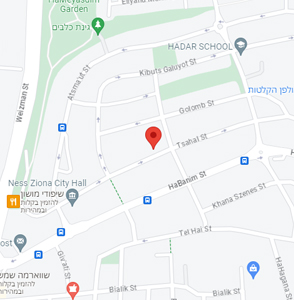
Getting here
17 Tzahal Street, Ness Ziona. Parking near the office, with service on the ground floor. The office is a short drive from Rehovot, Rishon LeZion and Yavne.
Get directions in Google MapsNot sure which certificate you need? Let's start with a conversation
Tell us which authority the document is intended for and for what purpose, and we will tell you exactly which notarial certificate you need, whether an apostille is required and in what order, and how much it will cost under the regulations.