
Certified Notarial Translation into English and Hebrew
Certification of the correctness of a translation under section 7(4) of the Notaries Law, from Hebrew into English and from English into Hebrew. Send a scan by WhatsApp and receive a signed, bound notarial certificate the same day or the next, with no need to come to the office and no personal identification.
Certified notarial translation in a 30-second video

The video loads from YouTube only when you click it. Go to the video page and transcript
In the video: A certified notarial translation is a translation that the notary certifies, by his signature, as true to the original, from Hebrew into English or the other way round. The fee for a certified notarial translation is fixed by the Notaries Regulations and is calculated by the number of words in the translation. And if the document needs an apostille for use abroad, that can be taken care of too.
- Advocate since 2003, notary licence no. 214444
- Fees fixed by regulation and published in advance, the same at every notary in Israel
- Remote service throughout Israel, the same day or the next
- Office in Ness Ziona for in-person collection and delivery when needed
What is a certified notarial translation?
A certified notarial translation is a translation of a document that a notary certifies, under his signature and seal, as correct and true to the original. The authority to do so is conferred by section 7(4) of the Notaries Law, 5736-1976. The certificate is attached to the translation and to a copy of the document, and they are bound together so that they cannot be separated without destroying the certificate. Authorities, courts, consulates and institutions abroad and in Israel accept it as evidence that the translation is accurate.
A notary is not merely a stamp. Under section 15 of the Law, a notary may certify a translation only if he commands both languages and has himself prepared the translation or verified its correctness. Responsibility for accuracy therefore rests with him, and not with an outside translator.
When you need a certified notarial translation
- When an Israeli document is submitted to an authority, embassy, university or employer abroad.
- In an application for foreign citizenship or a foreign passport, which usually calls for birth and marriage certificates and name-change documents.
- For the conversion of a driving licence, the recognition of a degree, and immigration and employment procedures abroad.
- When an Israeli authority asks for a certified translation of a document in English.
Documents commonly translated
- Birth certificate
- Marriage and divorce certificates
- Population Registry extract
- Matriculation certificate (Bagrut) and transcript
- Degree certificate and confirmation of studies
- Certificate of no criminal record
- Driving licence and vehicle registration
- Land Registry extract and real estate documents
- Power of attorney
- Will and inheritance order
- Death certificate
- Financial statements and balance sheets
- Judgments and decisions
- Agreements and contracts
- Certificate of incorporation and company documents
- Medical and hospital records
- Professional documents: engineering, technical and medical
Don't see your document? Send it to us and we will check. Under section 15 of the Notaries Law, a notary may certify the correctness of a translation only if he commands both the language of the original and the language into which it has been translated, and has himself prepared the translation or verified its correctness. The service here is therefore in Hebrew and English, in both directions.
How it works
Send the document
A PDF scan or a sharp photograph, by WhatsApp or email. Every letter and figure must be legible. A blurred image is the most common cause of delay.
Receive a fee and a delivery date
An exact word count, the fee under the regulations, and a delivery date. Work begins as soon as you approve.
Receive the signed certificate
The translation, the notary's certification and his seal, bound and fastened together in the prescribed form. Collect it at the office, have it delivered, or receive a scan by email.
Apostille, if required
If the foreign authority requires an apostille, it is issued at the Magistrates' Court on the original notarial certificate (section 45 of the Notaries Law). You may apply yourself, or the office can handle it for you.
What to send
- A PDF scan or sharp photograph of every page of the document, both sides where there is text.
- The spelling of names in English as it appears in your passport, so that the translation matches your other documents.
- The country and the authority the document is intended for, and whether an apostille is also required.
- No identification document is needed and you do not need to come to the office, because the notary certifies the correctness of the translation and not a signature.
What does a certified notarial translation cost?
Timing: A certificate or short document is usually ready the same day or the next, depending on when it arrives and how long it is. For a long or technical document, you receive a time estimate together with the quote. An apostille, if required, is usually added within one further business day.
The notary's fee is calculated by the number of words in the translation, not by the page. Enter an estimated word count, or paste the text for an automatic count, and you will see a full breakdown of the fee components, VAT and the total payable. You can also select surcharges, such as service outside office hours.
0 words counted
If a long press does not bring up the paste option, tap Paste from clipboard. You can also type an estimated word count in the field above.
Surcharges
The calculation follows item 3 of regulation 1 of the Notaries (Service Fees) Regulations, 5739-1978, as worded in the Notaries (Service Fees) Notice, 5786-2025, published in Collection of Regulations no. 12158 on 29 December 2025 and in force from 1 January 2026. This is a fee fixed by law and binding on every notary in Israel, not a variable quote. The final amount is determined by the actual word count.
2026 fee table
| Service | Before VAT | Including VAT |
|---|---|---|
| First 100 words of the translation | NIS 251 | NIS 296 |
| Each further 100 words or part thereof, up to 1,000 words | NIS 197 | NIS 232 |
| Each further 100 words or part thereof, above 1,000 words | NIS 99 | NIS 117 |
| Each additional certificate for the same translation, issued at the same time | NIS 77 | NIS 91 |
| Service between 19:00 and 08:00 the following morning, or on a day of rest | 50% surcharge | Under item 10 |
The tariff is adjusted on 1 January each year in line with the change in the Consumer Price Index, under regulation 4(d) of the Regulations. The amounts in the middle column are before VAT, as stated in the Regulations, and the VAT column is calculated at 18%. Numbers and dates also count as words, so even a short certificate may exceed the 100-word threshold.
Apostille: outside the notarial tariff
If the authority receiving the document requires an apostille, these are the costs. They are not included in the calculator above, because they are not a fee for a notarial service. A full explanation of the two apostille routes, and of the order in which to proceed, is on the apostille page.
| Court apostille fee, per documentA government fee, not subject to VAT. Updated on 1 January each year. | NIS 41 |
| Full handling of the apostille, at your optionIncludes submission at the court and delivery of the document to your door in central Israel. You may also apply yourself and pay only the fee. | NIS 250 plus VAT |
| Certificate not under the ConventionFor countries that are not party to the Hague Convention. Authentication by the Ministry of Foreign Affairs is also required. | No fee |
Certified notarial translation or translator's declaration?
There are two accepted ways of confirming a translation, and they are not equivalent. With a translator's declaration, the translator declares before an advocate that the translation is correct, and the advocate certifies only that the translator made the declaration. Neither of them certifies the correctness of the translation itself. With a certified notarial translation, the notary himself certifies that the translation is correct, and bears responsibility for it.
| Certified Translation | Translator's declaration | |
|---|---|---|
| Who certifies the correctness of the translation | The notary, by signature and seal | The translator declares; the advocate authenticates only the declaration |
| Legal basis | Section 7(4) of the Notaries Law | The rules of law governing affidavits |
| Command of the languages | Required of the notary himself, under section 15 of the Law | Required of the translator only |
| Fee | Fixed by regulation, the same at every notary | By agreement with the translator |
| When it is required | When the authority requires a "notarial translation" or a "certified notarized translation" | When the authority accepts a translator's declaration |
The practical rule: the body receiving the document decides which form of certification is required. If your instructions include the word "notarial" or "notarized", a translator's declaration will not be enough, and it would be a pity to pay twice.
Frequently asked questions about certified notarial translation
Do I need to come to the office?
No. Certification of the correctness of a translation does not require the client to be identified in person, so you can send a scan and receive the certificate back by post or email. The exception is obtaining an apostille, which requires the original certificate.
Can a translation be made from a copy?
Yes. A translation can be made from a photocopy or from a digitally signed document. The original needs to be presented only if the certificate is to state that the original was shown to the notary.
How long does it take?
A certificate or short document: the same day or the next, depending on when the document arrives and how long it is. A long or technical document will receive a precise time estimate together with the quote.
What about an apostille?
Whether an apostille is required is decided by the authority to which the document is submitted, not by us. Check with them whether they require one, and let us know. The apostille is placed on the original certificate at the court, so in that case the certificate itself must physically reach the court.
Who takes care of obtaining the apostille?
The choice is yours. You can collect the certificate at the office or receive it by courier, and go to the court yourself. Alternatively, we will handle it for you: NIS 250 plus VAT, and you will receive the apostilled document at your door in central Israel. On either route, the court fee of NIS 41 per document is payable in addition.
Why is the fee not negotiable?
The notary's fee is fixed by regulation and is the same at every notary in Israel, and a notary may not charge less or more than the regulations prescribe. The only surcharges the regulations recognise are for service outside office hours and on days of rest, and for an act performed outside the office.
Is a certified notarial translation valid abroad?
Yes, in most cases. Countries party to the Hague Convention usually also require an apostille, which is issued by the court on the notarial certificate. Countries that are not party to the Convention require authentication by the Ministry of Foreign Affairs and by the consulate. It is for the receiving authority to decide what is required, so it is worth confirming with them in advance.
What is the difference between a certified notarial translation and a certified true copy?
A certified true copy (section 7(3) of the Notaries Law) confirms that a photocopy of the document is identical to the original, without translating it. A certified notarial translation confirms that the translation into another language is correct. When a document is submitted abroad, both are sometimes required: a certified true copy of the original and a certified notarial translation of it. This can be done in the same certificate at no extra charge, provided the original has been presented to the notary.
What is the difference between an ordinary translation and a certified notarial translation?
An ordinary translation, even one made by a professional translator, carries no official certification of its correctness. A certified notarial translation comes with a notary's signed certificate, and that is what authorities and institutions require when a document is used for legal or administrative purposes. Full explanation, including the translator's declaration.
Certified notarial translation by type of document
Each type of document has its own points to watch: the spelling of names in personal certificates, legal terminology in judgments, and the validity period of a police clearance certificate or a company extract. The following pages give the details document by document, together with real examples from the office's work.
- Certified notarial translation of a birth certificate
- Certified notarial translation of marriage and divorce certificates
- Certified notarial translation of academic certificates and transcripts
- Certified notarial translation of a driving licence and vehicle registration
- Certified notarial translation of a police clearance certificate
- Certified notarial translation of documents for foreign citizenship
- Certified notarial translation of bank documents and statements
- Certified notarial translation of judgments and agreements
- Certified notarial translation of company documents
- Certified notarial translation of medical documents
See examples of certified notarial translations
Related pages: Apostille | Notary fees 2026 | Certified translation examples
Send a document for a quote
Attach a scan of the document and fill in your details. We will get back to you with a word count, the fee and a delivery date.
Contact us
The office is at 17 Tzahal Street, Ness Ziona, in an area with easy access and parking on site. Most notarial services are also available online, without coming to the office.
- Phone and WhatsApp052-5927592
- Email[email protected]
- Address17 Tzahal Street, Ness Ziona, parking nearby
- Opening hoursSun-Thu 09:00-19:00, Fri 09:00-12:30
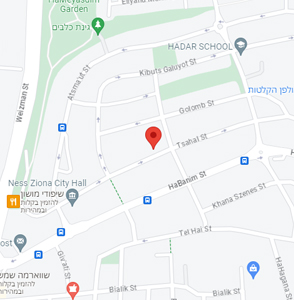
Getting here
17 Tzahal Street, Ness Ziona. Parking near the office, with service on the ground floor. The office is a short drive from Rehovot, Rishon LeZion and Yavne.
Get directions in Google MapsNot sure which certificate you need? Let's start with a conversation
Tell us which authority the document is intended for and for what purpose, and we will tell you exactly which notarial certificate you need, whether an apostille is required and in what order, and how much it will cost under the regulations.