
Apostille for Documents Going Abroad
An apostille is the certificate that allows an Israeli document to be accepted by an authority in another country. There are two separate routes: the Magistrates' Court for documents signed by a notary, and the Ministry of Foreign Affairs for certificates issued by an Israeli authority. This page sets out the precise distinction, the fees for 2026, and the route for countries that are not party to the Hague Convention. The apostille is issued under the Hague Convention of 1961 Abolishing the Requirement of Legalisation for Foreign Public Documents. On a document signed by a notary, it is issued by the registrar of a Magistrates' Court or by a public servant appointed for the purpose (section 45 of the Notaries Law).
Apostille in a 30-second video

The video loads from YouTube only when you click play. Go to the video page and transcript
In the video: An apostille is official confirmation of the notary's signature on the document, so that the document is recognised in the countries party to the Hague Convention. Whether an apostille is required is decided by the authority abroad, so it is worth checking with them in advance. You can receive the notarial certificate and go to the court yourself, or we can handle the whole process for you, including delivery to your door in central Israel.
When is an apostille required?
- When the document is intended for an authority in a country party to the Hague Convention, and that authority requires an apostille.
- On a notarial certificate, such as a translation, a power of attorney or an affidavit, that will be used abroad.
- On an Israeli public certificate, such as a birth certificate or a matriculation certificate, that will be submitted abroad.
Whether an apostille is required is decided by the authority that will receive the document, so confirm it with them before you begin. For a country that is not party to the Convention the route is different, as described below.
The process
Check
Ask the authority abroad what the apostille must be placed on: the certificate, the notarial certificate, or both.
Prepare the document
Have the notarial certificate prepared, for example a translation, or obtain the original public certificate.
Submit
A notarial certificate is submitted to the Magistrates' Court; a public certificate is submitted to the Ministry of Foreign Affairs.
Receive the document
The apostilled document is collected, or sent to you when the office handles the process.
What to bring
- The original document: the notarial certificate itself or the original public certificate. A photocopy is not accepted.
- Payment of the fee: NIS 41 per certificate in 2026.
- If you apply to the court yourself: up to ten certificates per visit.
Timing, fees and cost
Timing: when the office handles an apostille on a notarial certificate, it is usually added within one business day. If you apply yourself at the Magistrates' Court, the service is available during public hours, Sunday to Thursday, 08:30 to 13:30.
Cost: the fee is NIS 41 per certificate in 2026, paid to the authority. Full handling of the application and collection by the office: NIS 250 plus VAT, in addition to the fee. For an exact figure, see the notary fee calculator.
The fee was set in Collection of Regulations no. 6656 of 18 March 2008, and is updated on 1 January each year.
| Route | Fee per certificate, 2026 |
|---|---|
| Apostille at the Magistrates' Court | NIS 41 |
| Apostille at the Ministry of Foreign Affairs | NIS 41 |
| Certificate not under the Convention | No fee |
The fee is a payment to the authority and is not part of the notary fee. The notary fee itself is fixed by regulation and set out on the fees page. Fee vouchers from a previous year are not valid.
At the courts the service is available during public hours, Sunday to Thursday, 08:30 to 13:30, and up to ten certificates can be handled per visit. Some courts allow you to book an appointment in advance.
Where to apply, and why it depends on who signed
A document signed by a notary: the Magistrates' Court
A notarial affidavit, a notarial power of attorney, a certified true copy and a certification of the correctness of a translation all bear the notary's signature, so their apostille is issued at the court registry. The service is available at any court or regional labour court, except the Supreme Court, the National Labour Court and the local affairs courts. The authorised official at the registry verifies the notary's signature against the register of notaries.
Judgments and court decisions also receive their apostille at the courts, not at the Ministry of Foreign Affairs.
A certificate issued by an Israeli authority: the Ministry of Foreign Affairs
Birth, marriage and death certificates, Population Registry extracts, matriculation certificates, certificates of criminal record information, inheritance orders from the Registrar of Inheritance and certificates of incorporation are all public certificates issued by an Israeli authority, and their apostille is issued by the Consular Department of the Ministry of Foreign Affairs.
No notary is needed for an apostille on a certificate of this kind. You apply directly to the Ministry of Foreign Affairs and can do so yourself. That said, if you would rather not deal with it, you are welcome to leave it to us: the office provides this service for a fee, alongside the rest of the work on your documents.
The rule in one line
Signed by a notary: the court. Issued by an authority: the Ministry of Foreign Affairs. In practice, a single file often involves both routes: the original certificate is apostilled at the Ministry of Foreign Affairs, and its certified translation receives a separate apostille at the Magistrates' Court. These are two certificates on two documents, not a duplication.
| Document | Where the apostille is issued | Is a notary needed? |
|---|---|---|
| Notarial certificate: translation, power of attorney, affidavit, certified true copy | Magistrates' Court (section 45 of the Notaries Law) | Yes, the certificate itself is a notarial act |
| Judgment or court decision | The court | No, you can apply directly |
| Public certificate: birth, marriage, matriculation, certificate of criminal record information | Ministry of Foreign Affairs | No, you can apply directly |
Countries that are not party to the Convention
Where the document is intended for a country that is not party to the Hague Convention, an apostille will not be accepted there. Instead, a "certificate not under the Convention" is issued under the Notaries Law, 5736-1976, and the route is longer:
- The signature of the authorised official at the Magistrates' Court.
- Authentication by the Public Documents Authentication Branch of the Ministry of Foreign Affairs.
- The stamp of the foreign country's diplomatic mission in Israel, its embassy or consulate.
Without the third stage the document will not be accepted in that country. Israeli authorities do not publish a list of countries of their own; they refer to the official, regularly updated list of the Hague Convention. Before you begin, therefore, confirm with the authority that will receive the document which route it recognises.
What is an apostille placed on? A 30-second video

The video loads from YouTube only when you click play. Go to the video page and transcript
In the video: An apostille confirms to a foreign country that the Israeli document is genuine. It can be placed on the original document, or on the notarial certificate, for example on a translation. Sometimes both are needed. The authority abroad decides, so check with them before you begin.
Apostille and certified translation: in what order?
When a certificate is given a certified translation, there are two possible apostilles, one on the certificate and one on the notarial certificate, and each follows a different rule.
Apostille on the certificate itself: before or after, as you choose
The public certificate is apostilled on its own face, at the Ministry of Foreign Affairs. This step does not depend on the translation and can be taken either before or after the translation. There is no required order.
The only practical difference: if the certificate is apostilled before the translation, the apostille stamp itself is included in the translation; if it is apostilled afterwards, the translation covers the certificate alone. Both are correct, and what decides is what the receiving authority has asked for.
Apostille on the notarial certificate: always after the translation
Here there is no choice. The apostille is placed on the notarial certificate, and a notarial certificate exists only once the translation has been completed and signed. The apostille on the notarial certificate is therefore always the final step, after the certificate has been issued, and it is obtained at the Magistrates' Court.
Before you begin, the right question is not "which apostille do I need?" but "what exactly has the receiving authority asked for?": an apostille on the certificate, on the notarial certificate, or on both. Tell us the country and the purpose, and we will tell you what is required and in what order.
Frequently asked questions about apostilles
Does the notary issue the apostille?
No. The apostille is issued by the court or by the Ministry of Foreign Affairs, according to the type of document. The notary prepares the notarial document and, in many cases, also handles the application and collects the apostille on the client's behalf, but the stamp itself is the authority's.
How much does an apostille cost?
NIS 41 per certificate in 2026, on both routes. It is a fee paid to the authority and is not part of the notary fee.
I have a birth certificate to send abroad. What is the order of steps?
A birth certificate is a public document, so its apostille is issued at the Ministry of Foreign Affairs, and this can be done either before or after the translation. If a certified translation is also required, the notarial certificate is a separate document that receives its own apostille at the Magistrates' Court, and that is always the final step, once the translation and the certificate have been completed.
Do I need a notary to obtain an apostille on a birth certificate or a marriage certificate?
No. An apostille on a certificate issued by an Israeli authority is obtained by applying directly to the Ministry of Foreign Affairs, and no notary is involved. If you would rather not deal with it yourself, you are welcome to leave the task to us; the office provides this service for a fee.
The country I am sending the document to is not party to the Hague Convention
In that case a certificate not under the Convention is issued, and the route has three stages: the Magistrates' Court, the Ministry of Foreign Affairs and, finally, the stamp of that country's diplomatic mission in Israel.
Can the notarial certificate be apostilled before the translation is ready?
No. The apostille is placed on the notarial certificate itself, which exists only once the translation has been completed and signed. It is therefore always the final step.
How long the process takes
It varies according to the route and the workload. When you apply at the Magistrates' Court, the service is available during public hours, Sunday to Thursday, 08:30 to 13:30, and up to ten certificates can be handled per visit.
Contact us
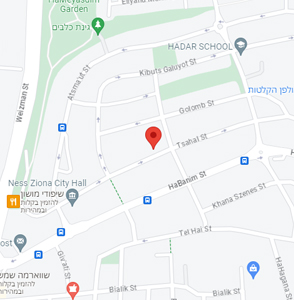
The office is at 17 Tzahal Street, Ness Ziona, in an area with easy access and parking on site. Most notarial services are also available online, without coming to the office.
- Phone and WhatsApp052-5927592
- Email[email protected]
- Address17 Tzahal Street, Ness Ziona, parking nearby
- Opening hoursSun-Thu 09:00-19:00, Fri 09:00-12:30
Getting here
17 Tzahal Street, Ness Ziona. Parking near the office, with service on the ground floor. The office is a short drive from Rehovot, Rishon LeZion and Yavne.
Get directions in Google MapsNot sure which certificate you need? Let's start with a conversation
Tell us which authority the document is intended for and for what purpose, and we will tell you exactly which notarial certificate you need, whether an apostille is required and in what order, and how much it will cost under the regulations.