
Certified Translation of Documents for Foreign Citizenship
An application for foreign citizenship or a foreign passport usually involves several documents: birth and marriage certificates going back several generations, a Population Registry extract and sometimes a life certificate. Where the country accepts documents in English, all of them are translated as a single set, with consistent spelling.
Foreign citizenship, in a 30-second video
The video loads from YouTube only when you click play. Go to the video page and transcript
In the video: In an application for foreign citizenship, the problem is usually not the translation but the spelling. The same name appears in several different documents, and each document spells it slightly differently. Settle on one spelling based on the passport, send all the documents together, and receive a consistent translation.
When a certified translation of documents for foreign citizenship is needed
- Citizenship by descent from a parent or grandparent.
- Issue of a foreign passport to a person already entitled to citizenship.
- Registration of children as citizens of the parent's country.
- Supplementary documents requested by the foreign authority after the application was filed.
The mistake that holds up applications
The mistake that holds up more applications for foreign citizenship than any other lies not in the translation itself but in the spelling of names. The same name appears on a birth certificate, a marriage certificate and a passport, and if it is spelt differently in each document, the authority abroad may send the file back. So before translating, decide on a single spelling for each name, based on the passport, and translate every document the same way.
Into which language
The office translates from Hebrew into English and from English into Hebrew. Some countries accept documents in English, while others require a translation into the local language. Check with the consulate, or with the lawyer handling the application, which language the documents are required in.
How it works
Send the document
Send a scan or a clear photograph by WhatsApp or email, and receive a quote based on the word count.
We translate and check the names
The translation must be faithful to the original document, and it is important to check the spelling of names against the passports, so that it matches the other documents.
The notary certifies and signs
The notarial certificate is signed and bound together with the copy of the document and the translation.
Apostille, if required
If the destination country is party to the Hague Convention, an apostille is added where required (please confirm this with the body requesting the document).
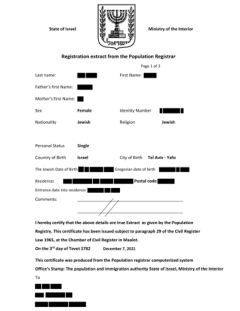
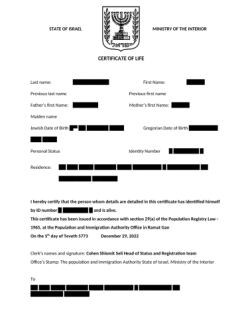
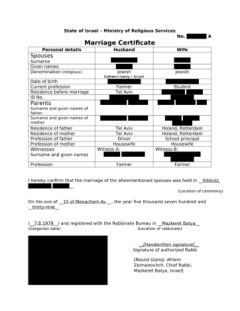
An example from our work
A real translation carried out at the office. All identifying details have been blacked out.
What it costs
The translation fee is based on the number of words in the translation, under the notarial tariff fixed by regulation, and it is the same at every notary in Israel. For an exact calculation by word count, see the certified translation fee calculator, and for the full tariff, the fees page.
The office translates from Hebrew into English and from English into Hebrew.
Questions and answers
Can all the documents be translated together?
Yes, and that is preferable. The spelling is then consistent across all the documents, and the quote is based on the total word count.
How long does it take?
A single document is usually ready within one business day, sometimes on the same day. If an apostille is required on the notarial certificate, it is obtained at the court, usually within one business day, by courier.
Need an apostille?
It depends on the destination country. In countries party to the Hague Convention, usually yes. It is best to confirm this with the body requesting the certificate.
Certified translation of other documents: Birth certificate | Marriage and divorce certificates | Academic certificates and transcripts | Driving licence | Police clearance certificate | Bank documents and statements | Judgments and agreements | Company documents | Medical documents
Contact us
The office is at 17 Tzahal Street, Ness Ziona, in an area with easy access and parking on site. Most notarial services are also available online, without coming to the office.
- Phone and WhatsApp052-5927592
- Email[email protected]
- Address17 Tzahal Street, Ness Ziona, parking nearby
- Opening hoursSun-Thu 09:00-19:00, Fri 09:00-12:30
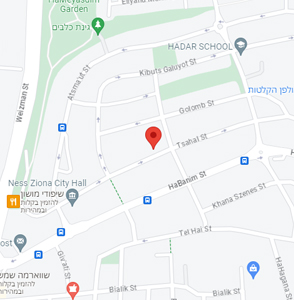
Getting here
17 Tzahal Street, Ness Ziona. Parking near the office, with service on the ground floor. The office is a short drive from Rehovot, Rishon LeZion and Yavne.
Get directions in Google MapsNot sure which certificate you need? Let's start with a conversation
Tell us which authority the document is intended for and for what purpose, and we will tell you exactly which notarial certificate you need, whether an apostille is required and in what order, and how much it will cost under the regulations.