
Notary at a Hospital, Care Home or Your Home
When the person who needs to sign cannot come to the office, the notary comes to them: to the hospital, the care home or their home. The law requires the signer to appear before the notary and sign in their presence (section 11 of the Notaries Law), and the notary must be persuaded that the signer understands the act and acts of their own free will. A person who is hospitalised or bedridden also needs a medical certificate issued on the same day.
When is a notary called outside the office?
When the person who needs to sign cannot come: they are hospitalised, bedridden, living in a care home or find it hard to leave home. The notary can certify a signature, take an affidavit, certify a will made before an authority or give a life certificate there too.
- A power of attorney for a family member, a bank or a transaction, when the signer cannot come. For a power of attorney for a real estate transaction, identification is by ID card or passport only (regulation 2(b1) of the Notaries Regulations).
- A will before a notary, when the testator is hospitalised or confined to home. See notarial will.
- An affidavit or declaration, for example for a court, a body abroad or the authorities.
- A life certificate for a pension fund or insurer, when the person cannot come. See notarial life certificate.
What must the notary check?
Two things, before any certificate: that the signer fully understands the meaning of the act and acts of their own free will, and, for a person who is hospitalised or bedridden, that a medical certificate in the form set by the regulations, issued on the day of the act, has been presented.
- Understanding and free will: a notary will not give a certificate unless persuaded that the person before them acts of their own free will and fully understands the meaning of the act (regulation 4(d)). So the notary speaks with the signer, alone if needed, and does not rely on what family members say.
- A same-day medical certificate: a person hospitalised or bedridden needs a medical certificate in the form in the First Schedule to the regulations, issued on the day of the act, and it is attached to the copy kept by the notary (regulation 4(e)). A certificate from the day before is not enough.
- Identification: by ID card, passport or another public document with a photo, and for a power of attorney for a real estate transaction, only by ID card or passport (regulation 2).
- A person who cannot sign: if the signer is mute, deaf or blind, the notary states this in the certificate and how they were persuaded the person understood the act. For a person who cannot sign their name, their fingerprint takes the place of the signature (regulation 8).
How does it work, step by step?
Arrange in advance, prepare the document and the medical certificate, the notary comes, and the certificate is collected from the office or delivered by courier.
Send the document
Send the document to be signed by WhatsApp or e-mail, or describe what is needed, so we can check in advance that it is suitable and complete.
Set a time
Agree on a day and time. In a hospital, coordinate with the staff too, so the doctor can issue the medical certificate on the same day.
The meeting
The notary identifies the signer, speaks with them, explains the document and makes sure they understand and act freely. The signature is made before the notary.
The certificate
The notarial certificate is prepared at the office and collected from the office or delivered by courier. If an apostille is needed, that can be handled too.
What should you prepare?
A valid ID document, the document to be signed, and for a person hospitalised or bedridden, a medical certificate in the form set by the regulations, issued on the same day.
- A valid ID card or passport of the signer.
- The document to be signed, unsigned. If it is in a language the signer does not understand, arrange the translation in advance.
- A medical certificate in the form set by the Notaries Regulations, issued on the day of the meeting, for a person hospitalised or bedridden.
- If signing on behalf of another person, for example as a guardian, a document proving the right to sign.
How much does it cost?
Notary fees are set by regulation. On top of the fee for the act itself, going out of the office is NIS 645 for the first hour and NIS 197 for each additional half hour, plus travel expenses and VAT.
The fee for going out: measured from when the notary leaves the office until return, whatever the number of acts at that meeting. When several people receive a service at the same place and time, the travel expenses are shared between them. If the notary went out and the act was not performed for reasons not dependent on the notary, the notary is entitled to the going-out fee and travel expenses (item 9 of the Notaries Regulations (Service Fees), at the 2026 amounts).
After hours: the 50% surcharge for service between 19:00 and 08:00 or on rest days does not apply to an act outside the office (item 10). Weekend service is possible by prior arrangement.
The exact amount for the act you need can be calculated with the notary fee calculator, ticking the option for service outside the office.
At the office or outside it?
The certificate is the same. The difference is the fee, the coordination and, for a person hospitalised or bedridden, the medical certificate.
| At the office | At a hospital, care home or home | |
|---|---|---|
| The notarial certificate | Same | Same |
| Fee | The fee for the act under the regulations | The fee for the act, plus the going-out fee, travel expenses and VAT |
| Medical certificate | Not required | Required for a person hospitalised or bedridden, from the same day |
| Handing over the certificate | At the same meeting | Collected from the office or by courier |
Sources
- Notaries Law, 1976: section 11 (the signer appears before the notary and signs in their presence).
- Notaries Regulations, 1977: regulation 2 (identification), regulation 4(d) and (e) (free will and understanding; same-day medical certificate), regulation 8 (mute, deaf or blind; fingerprint).
- Notaries Regulations (Service Fees), 1978: items 9 and 10, at the 2026 amounts.
Wording checked on 21.11.2026.
Frequently asked questions
Is a medical certificate needed for a notary to certify a signature in hospital?
Yes. For a person hospitalised or bedridden, the notary will not give a certificate without a medical certificate in the form set by the regulations, issued on the day of the act (regulation 4(e) of the Notaries Regulations).
How much does a notary home visit cost?
On top of the fee for the act, NIS 645 for the first hour from when the notary leaves until return, and NIS 197 for each additional half hour, plus travel expenses and VAT (item 9 of the Notaries Regulations (Service Fees), 2026 amounts).
What happens if the signer does not understand the document?
The notary will not give a certificate unless persuaded that the signer fully understands the meaning of the act and acts of their own free will (regulation 4(d)). In that case the act is not performed, and alternatives should be considered.
Is the notarial certificate handed over on the spot?
No. When the notary comes to the client, the certificate is prepared at the office and collected from the office or delivered by courier.
Related pages: Signature certification | Notarial will | Life certificate | Notary fees 2026
Contact us
The office is at 17 Tzahal Street, Ness Ziona, in an area with easy access and parking on site. Notarial services are provided at the office, outside the office, or remotely where the law allows.
- Phone and WhatsApp052-5927592
- Emailamos@il-law.co.il
- Address17 Tzahal Street, Ness Ziona, parking nearby
- Opening hoursSun-Thu 09:00-19:00, Fri 09:00-12:30
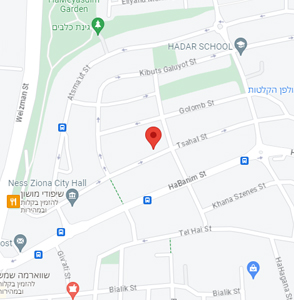
How do you get here?
17 Tzahal Street, Ness Ziona. Parking near the office, with service on the ground floor. The office is a short drive from Rehovot, Rishon LeZion and Yavne.
Get directions in Google MapsNot sure which certificate you need? Let's start with a conversation
Tell us which authority the document is intended for and for what purpose, and we will tell you exactly which notarial certificate you need, whether an apostille is required and in what order, and how much it will cost under the regulations.